Und Integration beginnt dort wo die Leute miteinander sprechen. Deswegen haben wir ein längst benötigter Treffen der IT-Integrationsspezialisten der Schweizer Strombranche durchgeführt (Details s. Flyer).
Es war die erste solche Gelegenheit Integration Verantwortlichen aus anderen Branchen-Unternehmen zu treffen, die wichtigsten Herausforderungen und Lösungswege zu besprechen und auch auf zukünftige Themen sensibilisiert zu werden.
Die Vertreter aus der führenden Unternehmen: BKW, CKW, EWZ, SBB, Swissgrid haben daran teilgenommen und die aktuellen IT-Integration Themen besprochen. Noch mehr Firmen haben ihre Interesse für die zukünftigen Veranstaltungen angemeldet.
Es wurde entschieden, das Treffen fortzusetzen, und sich im Herbst 2019, voraussichtlich zur Themen „EAI/ESB – Lösungen und Herausforderungen“ und „Smart Meter Integration“, zu treffen.
Pronoó is a young successful IoT start-up from Fribourg, Switzerland, that offers monitoring and automated measurements interpretation and heating system control, using sophisticated pattern recognition and optimisation algorithms to ensure energy savings around 15%.
It is necessary to monitor multiple customers and site locations (up to several hundreds) andto determine if their operation over time is running correctly. It can also be necessary to control and manage different parameters and settings, including IoT and communication infrastructure, scripts and tasks running, customer data, etc.
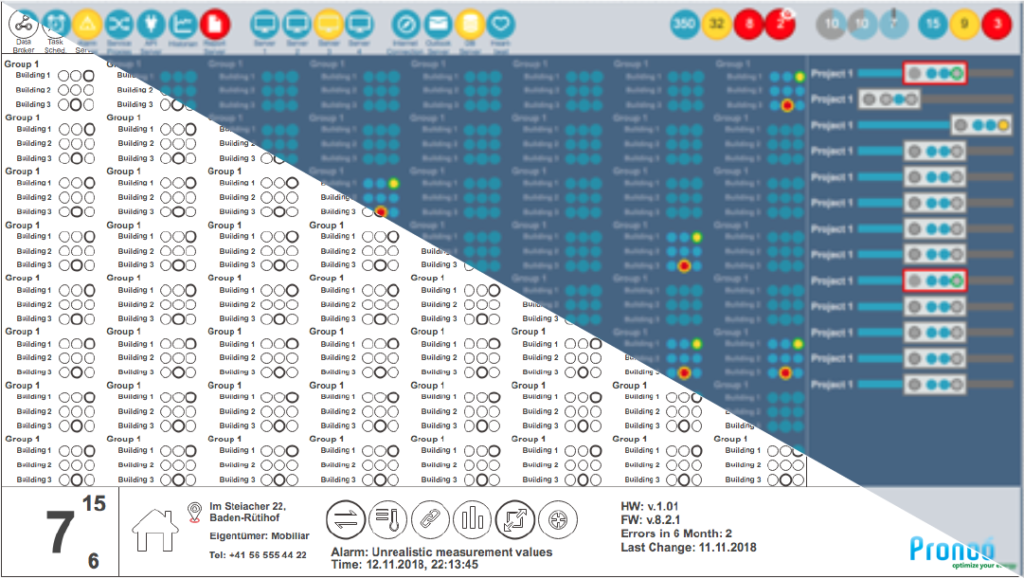
To support the growing business, the monitoring and control system shall be developed, withthe central operational dashboard, providing all the necessary information to the operationalmanagement team. This dashboard should display the real-time telematic data from the IoT devices, be scalable and provide fast and unambiguous situation overview for both operators and management of the company.
Resulting document
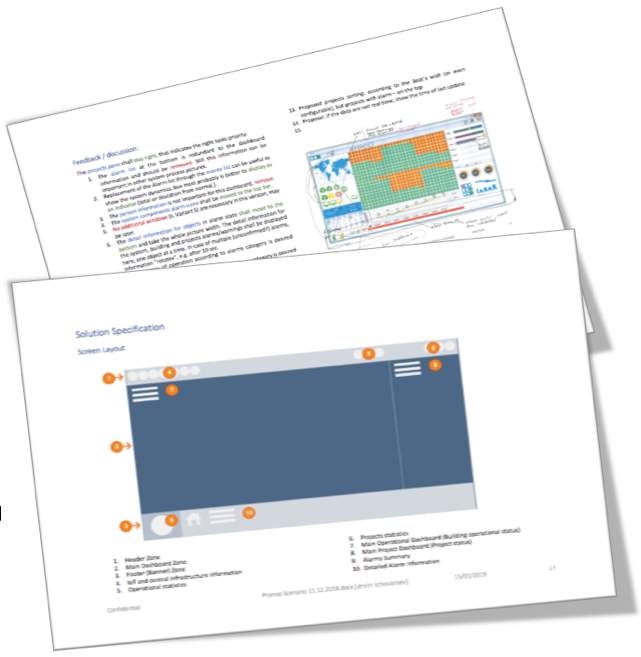
To address the problematic of Pronoó in the most efficient way, Design Thinking approach was applied, allowing open discussions and the wide problem definition in the first stages, and then fast convergence to the desired solution in the following stages. The main addressed topics were: the role of the dashboard in the overall company business processes, information to display (need-to-know vs. nice-to-know), the possible form of information presentation, as well as specific questions of remote system monitoring, including alarms, warnings, events and information quality management, to name a few.
The resulting document includes discussion results from the workshops, including different screen layouts with corresponding analysis and the information organisation and management guidelines for the solution selected.